
If you or a family member are worried about mouth or throat changes, this checklist explains the oral cancer screening signs clinicians use to decide when to investigate further. It draws on Canadian and international guidance so you can recognise true red flags, understand what an exam involves, and take clear next steps in Scarborough.
Checklist: oral cancer screening signs to watch for
Findings below do not prove cancer by themselves, but they are the common signs that prompt a professional oral cancer screening. Public health guidance recommends asking for an oral cancer screening if you notice persistent or unexplained changes in your mouth or throat; see authoritative symptom lists for more detail on Canada.ca and screening context from the National Cancer Institute.
1. Persistent mouth or tongue sores
Sores or ulcers that do not heal within two weeks should prompt assessment. Persistent non-healing ulcers are a commonly reported red flag and are referenced in Canadian public health advice as a reason to seek a screening (Canada.ca).
2. White or red patches
White patches, known as leukoplakia, or red patches, known as erythroplakia, on the tongue, gums, floor of mouth, or inner cheeks can represent abnormal tissue that needs further evaluation. These patches warrant a professional check even if they are not painful (Canada.ca).
3. Unexplained oral bleeding
Bleeding in the mouth without a clear cause, or bleeding that does not stop with simple measures, is an important sign to investigate promptly. Canada.ca lists unexplained oral bleeding among urgent signs to have assessed by a clinician (Canada.ca).
4. Lumps, thickened areas, or changes in texture
A new lump, a thickened spot, or an area that feels different when you press it are reasons to seek screening. Clinicians palpate the mouth and neck to detect these changes because they can indicate abnormal tissue growth (NCI).
5. Difficulty swallowing or persistent sore throat
Ongoing trouble swallowing, a persistent sore throat, or a sensation that something is caught in the throat should be evaluated. These symptoms may originate in the mouth, throat, or surrounding structures and are listed among screening triggers (Canada.ca).
6. Sudden change in voice or hoarseness, persistent for weeks
Voice changes or hoarseness that do not improve within a few weeks can reflect problems in the throat or larynx and should prompt an assessment that may include an oral and oropharyngeal exam (NCI).
7. Persistent ear pain
Ear pain without ear disease, especially when one-sided and persistent, is a less obvious but recognised red flag and appears in the Canadian symptom list as a reason to seek review (Canada.ca).
8. Numbness or loss of feeling in the mouth
Unexplained numbness, tingling, or loss of sensation in the tongue, lips, or other oral areas should be assessed. Altered sensation can signal nerve involvement and requires a professional exam (NCI).
9. Unexplained weight loss or persistent fatigue
Although these are less specific, significant unexplained weight loss or ongoing fatigue combined with local mouth symptoms should lead to prompt clinical evaluation, because systemic symptoms together with local signs may indicate advanced disease (Canada.ca).
How an in-office oral cancer screening works
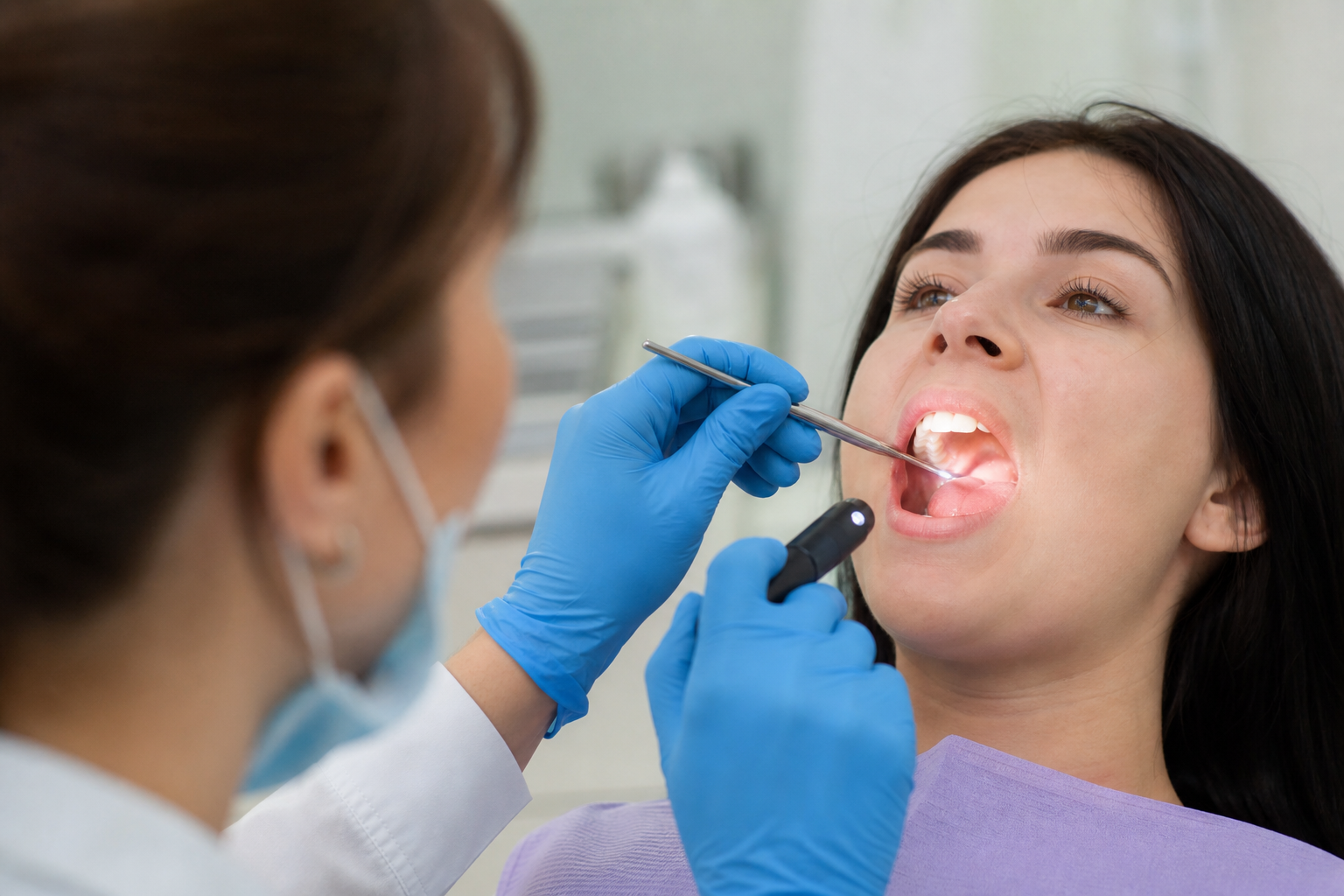
An oral cancer screening is usually quick and non-invasive. It can be part of a routine dental checkup or booked separately if you notice worrying signs. The screening looks for visible and palpable abnormalities so your clinician can decide whether further tests are needed (NCI).
What the clinician looks for
- Visual inspection of the lips, tongue, inner cheeks, gums, floor of mouth, and throat under bright light.
- Manual palpation of the mouth tissues and neck to feel for lumps or thickened areas.
- Assessment of mucosal colour, ulcers, patches, and tissue texture.
- When appropriate, the clinician may use adjunctive tools such as special lighting or fluorescence aids to highlight suspicious areas, but these are adjuncts, not replacements for clinical judgement (NCI).
How long the exam takes
Most screenings take five to ten minutes when performed as part of a routine exam. If the clinician finds a suspicious area, they will discuss next steps, which may lengthen the visit and include referral for biopsy or specialist assessment (NCI).
SR Smile Care offers oral cancer screening as part of preventive care; you can read more about their screening approach on their dedicated page oral cancer screening early signs benefits when to get tested and schedule an appointment through their main site SR Smile Care.
What screening can and cannot detect
Screening is a first step that helps clinicians find suspicious lesions early, but it is not a diagnostic test. Visual and manual exams identify abnormalities that need further investigation; only tissue testing, usually a biopsy, can confirm cancer. The National Cancer Institute notes that screening can miss disease and that visible lesions require follow-up testing to determine their nature (NCI).
Screening is a first step
If your clinician finds something suspicious, they will explain options such as watchful waiting with scheduled follow-up, referral to an oral surgeon or ENT specialist, or arranging a biopsy. Early detection improves management options, which is why follow-up is important (Canada.ca).
Why follow-up matters
A normal screen reduces immediate concern but does not guarantee that no abnormal tissue exists. New symptoms or changes after a normal check should be re-assessed, because screening is a moment in time rather than a permanent clearance (NCI).
Urgent red flags: when to seek care right away
Seek prompt professional evaluation or urgent care if you have any of the following:
- A non-healing mouth or throat ulcer lasting more than two weeks.
- Unexplained, persistent mouth bleeding that will not stop.
- New, rapidly growing lumps in the mouth or neck.
- Sudden, severe pain, or difficulty breathing or swallowing that progresses quickly.
- Persistent ear pain with no clear ear cause.
Canada.ca specifically lists non-healing ulcers, unexplained bleeding, and persistent ear pain as signs that warrant immediate assessment (Canada.ca). If you experience uncontrolled bleeding, severe pain, or breathing problems, call emergency services or go to the nearest emergency department.
Decision criteria: when to book a screening versus monitor at home

Use these practical rules to decide how quickly to act:
- Book an appointment within one to two weeks for any persistent sign that does not improve, such as a sore, patch, lump, or unexplained bleeding.
- Contact a clinician immediately for urgent red flags listed above.
- If you have risk factors such as current or former tobacco use, heavy alcohol use, or known HPV exposure, lower your threshold for screening and discuss routine checks at each dental visit. Canada.ca summarises these established risk factors and prevention advice (Canada.ca).
- Document changes with photos and note how long they have been present; this helps the clinician assess progression.
Common objections and clinician responses
Below are typical patient concerns and straightforward responses clinicians give.
“I have no symptoms, do I still need screening?”
Routine screening is sensible for adults at regular dental visits, especially if you have risk factors. A normal check is reassuring, but remain alert to new changes and report them promptly (NCI).
“Is the screening painful or invasive?”
Screening is non-invasive and usually painless. It consists of inspection and gentle palpation. Any further tests, such as biopsy, are explained and arranged if needed.
“I had a negative screen before; can cancer still develop?”
Yes. A negative screen means no suspicious signs were seen at that visit. New symptoms should always be rechecked because screening reflects the situation at one point in time (NCI).
Where to get screened in Scarborough and how to book at SR Smile Care
If you are in Scarborough and notice any of the signs above, SR Smile Care offers oral cancer screening as part of its preventive services. The clinic is located at 2190 Warden Ave., suite 205, Scarborough, ON, and welcomes new patients. For local details about screening and to prepare for your visit, see SR Smile Care’s service page oral cancer screening early signs benefits when to get tested or the clinic homepage SR Smile Care. You can call the clinic at +1 647-368-7785 to discuss symptoms and book an appointment.
What to bring to your appointment
- A list of symptoms and how long you have had them, and photos if available.
- Any relevant medical history and current medications.
- Your health card and information about public programs if applicable; SR Smile Care indicates acceptance of community programs such as CDCP on its practice profile.
Questions to ask the clinician
- What did you find and how worried should I be?
- Do you recommend immediate tests, a biopsy, or a specialist referral?
- How soon should I return for follow-up if we watch and wait?
Frequently asked questions
Is oral cancer screening part of a routine dental checkup
Yes. Many dental clinics include a visual and manual oral cancer screening as part of a routine checkup. If you have specific concerns, ask for a focused screening during your visit.
What are the most urgent signs that mean I should seek immediate care
Urgent signs include a non-healing ulcer longer than two weeks, unexplained oral bleeding, rapidly growing lumps, severe pain, breathing or swallowing difficulties, and persistent ear pain. If you have these, contact a clinician or seek emergency care.
How often should adults get an oral cancer screening
Frequency depends on risk. Many adults receive screening at every routine dental checkup. If you have risk factors such as tobacco or heavy alcohol use, discuss more frequent or targeted checks with your clinician (Canada.ca).
Do you accept new patients and public programs such as CDCP at SR Smile Care
SR Smile Care welcomes new patients and indicates program acceptance such as CDCP on its practice profile. Contact the clinic directly at +1 647-368-7785 to confirm eligibility and booking details.
If my screening is normal, does that mean I do not have cancer
A normal screening reduces immediate concern but does not rule out future disease. New or persistent symptoms should be rechecked because screening represents the status at the time of the exam (NCI).
If you have any of the signs described here, or if you are unsure, call SR Smile Care at +1 647-368-7785 or visit SR Smile Care to book an appointment.
Call to action: Learn more or book an oral cancer screening with SR Smile Care.